Syllabus
Writing 1 – Fall 2026
Section JMWF / ENG 2100
CUNY Baruch College
Professor: Jonathan Toro
Email: [email protected]
Class Time & Location: M/W 12:25-2:05 PM in RM A-17 Lex 1405.
Office Hours: M/W @11:00 AM -12 PM Please email me a few days in advance to arrange a meeting, either on campus or via Zoom.
Course Description:
In the course “Writing as Being,” we will examine how our identities, communities, and socio-historical contexts shape how we move through the world. Through personal narrative and critical writing, we will explore how language and culture influence our ways of knowing. Then, we will utilize these very influences to write ourselves into being.In this space, “being” is not a passive state of existence. As Lois Elaine Griffith, co-founder of the Nuyorican Poets Cafe, once reminded me, being is also to “be in”—it is about how we use our unique knowledge to actively navigate and occupy our everyday spaces. To explore these themes, we will engage with a rich multitude of literature, including essays, poetry, videos, and academic articles, focusing on genre, audience, and rhetorical strategies. By studying published creators, you will develop your own powerful voice for both academic and personal spheres. This journey features diverse writing assignments designed to deepen your self-exploration, culminating in a research-based project that bridges your personal experiences with broader social contexts. Ultimately, you will gain the confidence to share your unique narrative with the world.
Course Materials:
Please bring the following to each class:
– Yourself: Your knowledge, experiences, and energy are essential for our collective learning and creating “freedom spaces,” as described by Robin D.G. Kelley.
– Assigned Readings: Complete either a hardcopy or digital version before class to facilitate meaningful discussions.
– Note-Taking Materials: Bring a laptop, tablet, or notebook for notetaking, reflections, and responses.
– In-Class Journal Notebook: Also have a dedicated notebook, or sheet/folder in your device, separate from your note-taking notebook, for in-class free-writing assignments.
– Supplementary Materials (Optional): Consider bringing images, songs, literature, videos, films, or other media relevant to the course themes to enrich our learning experience.
Weekly Reading & Writing:
In addition to the major projects outlined below, you will have weekly readings and writing assignments. Much of the weekly work will contribute to the development of your major papers/projects. You are encouraged to integrate elements from your notes and weekly writing assignments into your major papers, writing them as you progress through the course.
Below you’ll find the components of this part of the course:
– Readings: You will have readings for every class (subject to change). Please come to class prepared to discuss a specific section of the reading—whether it be a sentence, paragraph, page, word, question, or theme—as this is part of your participation credit.
– Free-writes: At the start of each class, we will engage in a 15-minute free-write. I will ask you to write these in your in-class writing journal notebook. A suggested prompt will be provided, aligning with the course description and upcoming projects; however, you are welcome to write on any topic that inspires you that day. These free-writes are intended as warm-up activities to help you position yourself into the writing mindset and will not be graded.
– Drafts: You will submit three drafts throughout the semester, with each draft due a week or two before the corresponding Major Project is due. You will submit one draft for each major project. The drafts will be reviewed during our in-class one-on-one meetings, allowing us to assess your progress and ensure you are on track to complete the Major Project. Please notify me if you would like a one-on-one for your second drafts. All draft submissions are worth 3-4%, totaling 10% of your overall grade.
Readings:
Good news: there is no textbook to buy! This course is completely ZTC (Zero Textbook Cost) and uses Open Access Open Education Resources (OER) materials. Head over to the schedule page to find links and PDFs for all weekly readings.
Resources:
Course resources are available via the resource page.
Major Projects:
You will have three Major Projects this semester: a literacy narrative, an analytical-based essay, and a research paper. For more information on the assignments, visit the Major Projects page.
Grading:
I use a 100% grading scale to assess individual assignments and your final course grade. The breakdown is as follows:
- Attendance – 30%
- Project 1 (Literacy Narrative) – 15%
- Draft #1 – 3%
- Project 2 (Analytical Essay) – 20%
- Draft #1 – 3%
- Project 3 (Research-Based Essay) – 25%
- Draft #1 – 4%
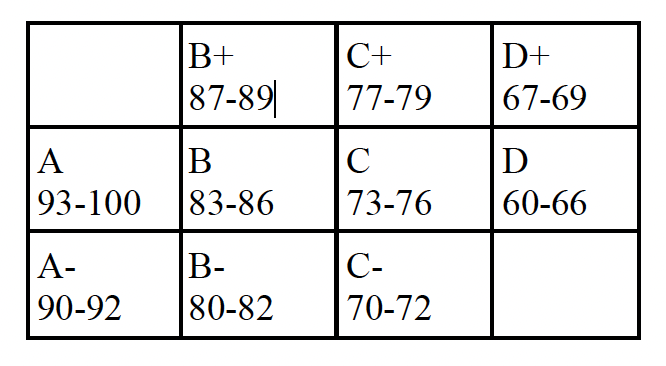
Attendance:
Attendance is very important! Make sure you attend every class session. Participation credit will be based upon activities, discussions, etc., that will occur during class. So please make sure that you attend the course on time and in a consistent manner. Grades for participation are outlined in the rubric below.
Participation makes up 30% of your overall grade. 1% is the maximum grade you will be rewarded for each class. There are 30 classes in total this semester. 1% will be rewarded each time you come to class on time and participate actively. Active participation includes answering questions, engaging respectfully in discussions, submitting drafts by or before the deadline, participating in in-class activities, journaling, and staying awake! Simply being present in class will earn you an attendance point. Presence here means that you are engaging with the course material and class, participating in workshops and writing exercises, and speaking and listening during each session.
Points will be deducted for lack of participation, with a deduction of 1%. Just showing up is not sufficient to earn credit! So, make sure you arrive promptly, engage actively, and plan to stay for the entire class. This expectation also applies to days when we conduct in-class one-on-ones and work on drafts.
You are allowed up to 2 excused absences before late/absence penalties are applied to your grade. Three latenesses culminates into 1 unexcused absence. Any absences beyond the 2 excused ones will result in a deduction of 1% from your attendance grade. Excused absences do not require additional documentation, but repeated absences may necessitate a meeting to discuss your attendance. It is your responsibility to obtain any missed material or assignments from classmates when absent, excused or otherwise.
Individual One-on-One Meetings:
A week before each Major Project is due, we will have two class sessions dedicated to individual one-on-one meetings. During these one-on-one sessions, you will come to class prepared to show me the current draft of the upcoming project.
These one-on-one meeting days are included in the attendance grading. Showing up for these sessions will guarantee you 1% towards your attendance grade, and having a draft will guarantee you those points.
While I conduct the individual meetings, the rest of the class will utilize the time for writing and working on their projects.
Course Goals:
After completing ENG 2100, you should be able to:
1. Compose as a process: Experience writing as a creative way of thinking and generating knowledge, and as a process involving multiple drafts, review of your work by members of your discourse community (e.g, instructor and peers), revision, and editing, reinforced by reflecting on your writing process in metacognitive ways.
2. Compose with an awareness of how intersectional identity, social conventions, and rhetorical situations shape writing: Demonstrate in your writing an awareness of how personal experience, our discourse communities, social conventions, and rhetorical considerations of audience, purpose, genre, and medium shape how and what we write.
3. Read and analyze texts critically: Analyze and interpret key ideas in various discursive genres (e.g., essays, news articles, speeches, documentaries, plays, poems, short stories), with careful attention to the role of rhetorical conventions such as style, trope, genre, audience, and purpose.
4. Identify and engage with credible sources and multiple perspectives in your writing: Identify sources of information and evidence credible to your audience; incorporate multiple perspectives in your writing by summarizing, interpreting, critiquing, and synthesizing the arguments of others; and avoid plagiarism by ethically acknowledging the work of others when used in your writing, using a citation style appropriate to your audience and purpose.
5. Use conventions appropriate to audience, genre, and purpose: Adapt writing and composing conventions (including your style, content, organization, document design, word choice, syntax, citation style, sentence structure, and grammar) to your rhetorical context.
CUNY Pathway Goals:
1. Read and listen critically and analytically, including identifying an argument’s major assumptions and assertions and evaluating its supporting evidence.
2. Write clearly and coherently in varied, academic formats (such as formal essays, research papers, and reports) using standard English and appropriate technology to critique and improve one’s own and others’ texts.
3. Demonstrate research skills using appropriate technology, including gathering, evaluating, and synthesizing primary and secondary sources.
4. Support a thesis with well-reasoned arguments, and communicate persuasively across a variety of contexts, purposes, audiences, and media.
5. Formulate original ideas and relate them to the ideas of others by employing the conventions of ethical attribution and citation.
Plagiarism:
Please make sure that you DO NOT PLAGIARIZE!!! All work submitted for this course should be original, created specifically for our projects. Compose your projects ethically, meaning that if you use the work of others, you must cite it according to MLA format.
Plagiarism is defined as presenting another’s ideas, research, or writing as your own. This includes:
- Copying another person’s exact words without quotation marks and proper citations (generally, four or more words taken directly from another’s work).
- Rephrasing another person’s ideas or theories without proper acknowledgment.
- Using information not considered common knowledge without citing the source.
Engaging in plagiarism may lead to serious consequences, including a failing grade on the assignment or, depending on the circumstances, a failing grade for the course. It is a significant offense that can result in a mark on your permanent academic record.
I know the weekly readings and class discussions can be challenging, but I really want you to TRY your best to express your own thoughts and ideas. Using your own voice is so much better than taking the easy way out by plagiarizing. If you have any questions or concerns about plagiarism, please don’t hesitate to ask me. You can also check out the Newman Library Plagiarism Tutorial and familiarize yourself with Baruch College’s academic integrity policy at Baruch Academic Integrity Policy.
AI Policy:
In the summer of 2024, the CUNY Board of Trustees approved policies that identify the use of generative AI (artificial intelligence) without permission from the instructor as a violation of the academic integrity policy, as is copying or paraphrasing the content generated without citation. It is the student’s responsibility to be aware of and follow the academic integrity policies. You can read the full policy here.
I strongly encourage you NOT to use AI tools for your projects. Your unique perspectives, ideas, and ways of understanding the world—your ontologies and epistemologies—are invaluable and cannot be reproduced by artificial intelligence. I want you to engage with your own thinking, writing, and problem-solving skills.
However, if you wish to use generative AI, you must discuss your intent with me beforehand. Together, we can explore how to use these tools responsibly and effectively. Your specific intention for using AI will determine whether I allow its use for your project. Failure to consult with me before using AI will result in a requirement to rewrite the assignment and a grade deduction based on the extent of AI usage.
If you decide to use generative AI in your work, you must approach it ethically and critically. You should inform me of your use of AI and clearly outline its role in your assignment. Additionally, engage with the AI as you would with any other tool: reflect on how it aids or hinders your research, writing process, or overall thinking. This critical engagement will enhance your understanding and ensure that your work maintains your voice and ideas as well as the integrity expected in this academic environment.
I’m happy to have an open discussion about the ethical and critical use of these technologies, providing the appropriate literacy for engagement with the tool. Please speak to me if you have any questions or concerns about these policies.

